Tuesday, September 23, 2008

Death of the Inconvenient

What was the point of fighting the Nazis?

The thought had occurs to me many times, especially on the countless occasions I have heard WW2 described as the "Last good War". You had the Nuremberg Trials, where all those nasty people like Herman Goering were called to account for their sins against humanity. Obviously there were problems about what you were going to charge them with. The British, Belgians and Dutch could accuse them of wanting to build a huge empire, the Americans could accuse them of blatant racism, the French could accuse them of Antisemitism (and building a huge empire), the Russians could accuse them of running torture chambers and concentration camps.

It was not just the big fish like senior politicians and generals who were dragged into the dock. Little people like doctors who practiced euthanasia found themselves in court, even though they could truly protest that they were not "obeying orders"... they were acting voluntarily to relieve suffering. And people like the medical experimenters in concentration camps were held up to public condemnation as obviously the vilest of the vile.

Unfortunately the message did not get through to numerous British and American doctors. Vulnerable people have always been at the mercy of the medical profession. George Orwell, writing in the 1930s, referred to "a sinister minority of doctors whose motives are suspect". In a grim Paris hospital around 1929, he had seen two doctors almost kill a poor patient in a mischievous experiment which they probably would not have dared to try on a wealthy client with influential friends. After the Nuremberg trials, you might have thought that even the doctors would have learnt their lesson.

But, only a few years after Nuremberg, British doctors were experimenting on military personnel. In the 1950s, they tested poison gas on soldiers at the Porton Down research laboratories. This is one of the most sinister places in England. Set in lovely countryside, only a short drive from the magnificent Salisbury Cathedral, it is the centre for research into chemical and biological weapons. Of course, the experiments went too far, as they always do, and they killed at least one soldier and maimed several others. One writer found at least 300 experiments on humans in the 1950s and 1960s by trawling through the British and American scientific literature. And these were obviously only the results which were published, albeit in the specialist pages of the medical reviews which few non-medical people ever read. The ones where they killed or maimed too many of their victims would be suppressed or circulated only in discreet home-produced documents. Obvious experimental subjects were people in asylums, old people's homes or orphanages, with no concerned relatives outside to defend them. Prisoners and military personnel under strict discipline were also good material.

The Nazis are slowly sliding into forgotten history, despite the best efforts of the movie makers and British tabloids. One widely traveled German friend commented to me that she had never visited any country which had such an obsession with WW2 as Britain....not even France, which was occupied for four years.

But it is obviously the wrong lessons which are being remembered. How else do you explain any person in public life daring to suggest killing the most helpless members of society? And this was not a Nazi nutcase. It was Lady Warnock (pictured with Geoffrey), one of our most influential ethical pundits and a long time participant in any number of public enquiries and commissions into medical issues. In a recent article she stated:
"If you're demented, you're wasting people's lives – your family's lives – and you're wasting the resources of the National Health Service".
This must be the first time I have heard a yearly budget of £75 billion ($140 billion) described as "very limited", though I suppose it is by Government standards. When there are more urgent needs, like pissing $35 billion down the toilet on a useless computer system for the NHS and paying doctors enough to buy new Audis (see the ludicrous Michael Moore's "Sicko"), I suppose elderly people count for very little.

Lady Warnock's Article (A Duty to Die?) was at least a useful corrective to Moore's typically fatuous documentary, which seemed to imply that the British NHS treated any sick person immediately for free. Of course, this has never been the case. Any number of people have been denied treatment that would prolong or improve their lives because it was not available on the NHS. I have lost count of the number of appeals for various people who need £x thousand pounds to go abroad (usually to the reviled and overpaid US doctors) for treatment which is unavailable in Britain. With the opening up of the East European economies, medical care is available in Budapest and other cities for a fraction of the price British private doctors charge. And even when "free" care is available on the NHS, it is seriously deficient compared with the best available. So even though artificial limbs are provided on the NHS, some patients go to private companies which provide more comfortable or more functional alternatives, even for thousands of pounds a time. Talk about costing an arm and a leg......

But enough of my rantings... Read Melanie Phillips' hatchet job below.

September 22, 2008

The Dehumanised Landscape of Planet Warnock

Daily Mail, 21 September 2008

Has there ever been anyone who has displayed more inhumanity towards her fellow human beings, and yet had more influence over British society, than the noble Baroness Warnock?

In an article for a church magazine, Lady Warnock has declared that elderly people with dementia are ‘wasting’ the lives of those who care for them, and have a duty to die in order to stop being a burden to others.

On pitiless Planet Warnock, people are valued in proportion to their ability to lead an independent life. If they can’t do so, they are to be written off as valueless — and even more nauseating, they are being told they actually have a duty to end their lives.

The elderly and chronically sick - — indeed, anyone who constantly depends on others for care — often dread being a burden on their nearest and dearest. To be told that they must end this burden by finishing themselves off can only increase their guilt, despair and suffering.

On Planet Warnock, it seems that ties of family and kinship, acts of selfless love, the deep satisfaction from bringing comfort to those who are helpless or who are so poignantly leaving us — essential aspects of our common humanity — mean nothing at all.

To be sure, those who are forced to watch a spouse or close relative descend into dementia often suffer immeasurably from this tragic process. All the more reason, therefore, for protecting those who have lost their minds from any pressure from relatives to end their lives, and not — as Lady Warnock is doing — adding to that pressure still further.

Sufferers and relatives should be helped through the provision of better treatments and improvements in care. To say that the demented should instead end their lives shows a quite chilling absence of elementary human sympathy.

And just how does she propose such people should bring this about? She is, after all, talking about people who have lost their minds. How can people who are mentally incapable possibly be expected to take such a decision?

Does she mean they should take it their minds have disintegrated — in which case, their quality of life will still be good and the pressure on relatives will be relatively light? Should their ‘duty’ to die perhaps kick in the very moment they receive the diagnosis of dementia?

Or does she mean that all of us should sign living wills instructing doctors to end our lives if we should ever suffer from dementia in the future — without knowing whether we would be a burden on anyone at all, or indeed whether, if such a disease did strike us down, we would still rather like to continue to live, thanks very much?

One gets the feeling that such practicalities don’t matter much to Lady Warnock. What drives her is simply the belief that lives which she considers to be worthless should be ended. Down this particular road, of course, lie the historic spectres of eugenics, the concentration camp and the gulag.

Tempting though it may be, it would be a mistake to treat this elderly philosopher as an eccentric who can be safely ignored. Lady Warnock is a key figure in the development of medical ethics in this country, from research on embryos to the debates over euthanasia.

Although the days when governments called upon her to serve on such committees of the great and the good may be over, her thinking provides graphic evidence of the slippery slope down which we are sliding at terrifying speed.

What she originally presented as the ‘right to die’, for example, soon mutated into the ‘duty to die’. The claim that euthanasia would benefit sick people by ending their pain is thus revealed as a fraud. The real point is to benefit the sick person’s relatives, in whose interests the patient must be expected to forfeit life itself.

For the ‘right to die’, therefore, read instead ‘no right to live’.

The impulse to end lives considered to be worthless is sliding from cases involving people in an irreversible coma to people who still have their senses, but have lost the power of rational thought.

The watershed was the Law Lords’ judgment in 1993 that allowed doctors to withdraw feeding and hydration from Anthony Bland, the Hillsborough victim who had been left in a persistent vegetative state.

Subsequently, the Mental Capacity Act, which came into force last year in the face of huge disquiet and after a fudged to die’ is a ‘wholly bogus distinction’.

It is a view she carried into practice when she watched her incurably ill husband, Geoffrey, accept the help of a family doctor to take lethal doses of morphine in order to end his life.

This is because Lady Warnock’s thinking follows the ‘consequentialist’ doctrine which looks at the result of an action, regardless of its motive. Hence, she sees no distinction between a drug administered to alleviate a dying patient’s suffering that ends up hastening that person’s death, and a drug deliberately given to bring about death.

But intention is the essence of morality. It means the difference between murder and manslaughter; between an attack and an accident; between killing and allowing someone to die.

Consequentialists similarly think there is no intrinsic value in a human life; the only value lies in the quality of the life that is being lived. That’s why Lady Warnock thinks that if people have lost their faculties, they should forfeit their existence to benefit others whose lives are — in her eyes — worth more.

This is indeed the path to barbarism. But Lady Warnock is by no means alone in holding these views. They are mainstream among our secular, anti-religious elites - and alarmingly, nowhere more so than in the medical profession.

The Royal College of Obstetricians and Gynaecologists, for example, said two years ago that ‘active euthanasia’ should be considered to spare parents the emotional and financial burden of bringing up seriously disabled newborn babies. These doctors were advocating killing newborn infants for the presumed benefit of others.

A terrifying, amoral landscape is opening up before us, brought into being by the philosophy embodied by Lady Warnock — the garlanded intellectual, whose epitaph will be a dehumanised society where the weakest are being steadily sacrificed for the benefit of the strong. This is the way civilization dies.

Friday, September 12, 2008

Church on the Cheap

I was walking past the Comfort Inn, an unremarkable hotel on Christchurch Road, when I saw a banner attached to the railings: "Potter House Christian Fellowship". The banner told me that they meet in the hotel at 11:00 am and 6:30 pm on Sundays and 730pm on Wednesdays. After 150 years we have a second place of worship in Christchurch Road. The fine Victorian structure of Christchurch itself is 50 yards away on the other side of the road.

Can market differentiation go much further in Christian worship? In Reading we already have Catholic, Methodist, Baptist, Quakers, United Reform, plus multiple flavours of Anglicanism. These are the most subtle and confusing. Christchurch itself is mainstream Anglican (judge by the reference to "Sunday Eucharist" on the noticeboard outside. St Giles, ten minutes walk away is more Papal than the Pope. There was talk of St Giles defecting en masse (if you'll pardon the expression) to Rome after the uproar over the ordination of women in the 1990s. St Marys, five minutes from St Giles, would have a fit at the suggestion of anything Romish and is sternly devoted to the Book of Common Prayer. Greyfriars, less than 5 minutes walk beyond St Marys, is the exemplar of happy-clappy evangelicalism.

Yet all these long established congregations, in solid purpose built (and often historic and beautiful) premises, do not satisfy all the spiritual requirements of the local population. there is constant multiplication of small "churches" that do not fit any established pattern, beyond an apparent devotion to the Bible. In an earlier post I mentioned the fellowship which has established itself in a large house on Wokingham Road, plus the mysterious "Brethren" who have large modern premises on Redlands Road and are moving to much bigger accommodation ten minutes drive away. A longer established "Mount Zion" church is tucked away in a little road off the Wokingham Road.

All these involved serious money to build and maintain. Something like "Potter House" involves only paying rent for a hotel lounge as and when required. The pastor needs only a cheap family computer for email and printing off newsletters and service sheets (if it is a style of worship which requires written guidance). The congregation would bring their own Bibles, if needed. If the pastor has a full time job and officiates only on Sunday and Wednesday, costs are minimal. Given the meeting times, the hotel might well provide the lounge for free as long as the congregation paid for a buffet lunch/supper. It is another regular income stream which hotels never thought about 20 years ago. It is not the first example in town; the Christian Science group meets in the Ship Hotel in Duke street.

The "Potter House" banner displayed a quotation from Jeremiah. How it actually interprets Jeremiah or any other part of Scripture might be open to interpretation. The more talk there is of "Christian unity" in theory, the more visible disunity there is in practice. As the official efforts on "Ecumenism" accelerated in the 20th century, doctrinal and morality splits between churches and within churches multiplied like a metastatic cancer. Contraception, divorce and remarriage, ordination of women, the nature of God, the Resurrection, the Incarnation, the role of Mary, the Eucharist..... As heroic efforts were made to achieve union between Rome and Canterbury, internal divisions and disputes made the exercise ever more fatuous. The expansion of "House Churches" and mini-churches seems to have no limit - except the ultimate limit where very family and eventually every person is his/her own church, Pope and congregation.

Wednesday, September 10, 2008

Calling for Help

It was a Saturday evening in mid summer on Caversham Road. I was walking back to the car park when I came across a man collapsed on the sidewalk with a man and a woman standing over him. He was sitting up, but could not rise to his feet. He was perhaps in his late twenties and plainly in a confused state. It was difficulty to tell if this was some mental problem or a result of drink/drug abuse, but he was visibly in no condition to help himself for the next hour or so. The man and woman had no previous connection with him; they had found him a minute or two earlier and were plainly as clueless as me as to how to effectively help him.

I called the ambulance service using my cellphone. This was only the second time in my life that I had called 999 (the UK equivalent of 911) and the first time I had ever called for an ambulance. Now the young woman on the other end was giving me a hard time...."Did he ask for an ambulance...does he want an ambulance?" This was tricky when I was standing close to the guy and did not know how much he understood of what he NEEDED, as opposed to what he wanted. Also it was difficult to convey the urgency of what I thought might be needed without possibly seriously offending him. He seemed to have twisted his ankle as he collapsed, but of course none of us knew if it might be broken or how much pain he was feeling (or would be feeling if he was not in such a fuddled condition). He was not in immediate danger (unless he staggered into the busy road eight feet away) and was hardly likely to die of exposure even if he stayed on the sidewalk all night. But I did not want to leave him without getting some assurance of professional help.

Finally she agreed to send an ambulance. I was getting seriously uptight by this time, seeing that I was struggling to explain a delicate situation with the background roar of traffic on one of the busiest roads in town. The fact that the ambulance depot is barely 300 yards away off Caversham Road did not improve my temper.

As we waited two policemen on bicycles approached and I flagged them down. It felt like a Good Samaritan situation, but circumstances have changed since AD30. You can imagine the reaction if I had taken this man to a hotel, given them my credit card details and asked them to look after him. I could have given him a ride to my own house and put him in the spare bedroom. Or given him a ride to his own place...but we were having problems getting any coherent information out of him, much less a name and address. And we plainly had no authority to go through his pockets for ID. I could have taken him to the Salvation Army hostel less than 600 yards away, but I doubt if they would have accepted someone under the influence of unknown chemicals. I should add that none of these "Good Samaritan" actions occurred to me at the time. It was much easier to wash my hands, leave him in the care of the two young constables and head on to the car park.

Incidentally these police looked hardly old enough to shave. It used to be said that you were getting old when the policemen started looking young. I passed that some time ago. You have to get really worried when the new mayor of Reading looks young. But these kids....are they protecting us from Bin Laden????

As I approached my car, the two young constables reappeared on their bicycles. They had not chased after me; it was just another part of their patrol route. They said that the ambulance had come and the man just had a sprained ankle. And I have not seen him since or seen any reports of unidentified bodies discovered. On reflection many weeks later, it struck me that the guy might have suffered a stroke, which might have resulted in slurred speech and paralysis, but it plainly did not occur to me or the ambulance lady at the time.

It is surprising that you see so few people in such straits. The mass drinking and drugs abuse culture has been in full swing for well over 10 years now. Many of the carefree young revellers so noisily visible around town in the early 1990s have doubtless progressed to alcoholism, the acute liver disease specialists and even the graveyard. But I have not noticed as much of the grim results as you might expect.

Perhaps I should get out more, as the old jibe says. But then I don't want to "get out" in town at the times when so much of the drunken revelry is in full swing. We have already had several scary public order incidents around town, the worst being in March 2002 when the police lost control of part of the town centre for a few hours after a riot outside a night club in London Street.

So who do the police call when they need help? In that case, it was more police from neighbouring forces who finally arrived in sufficient numbers to regain control of the town centre. Presumably all the senior police were fervently praying that there wouldn't be an incident in one of the towns from which they had taken officers to support Reading......or that there would not be a bad accident on the M4 motorway which would similarly require officers which they did not have. On that occasion they got away with one bad incident on one Saturday night.

I suppose I should be grateful that my incapable guy in Caversham Road was merely passive and helpless. One of the inmates at a local charity house was 6 foot two, built like a gorilla and had a weakness for vodka, LSD, cocaine, heroin and amphetamines in various combinations. Thus he could be a seriously scary guy once he was out of control. Mercifully I have never met him in Caversham Road or any where else. We would have been calling for more than one ambulance.

Tuesday, September 9, 2008

Cementing Their Partnership

Saturday 30th August. A beautiful wedding day in a traditional English church at Burghfield, south-west of Reading. St Mary the Virgin has a traditional lych-gate, a traditional graveyard, a traditional pair of stone effigies inside the main door and a traditional peal of bells. To my delight, I later discover that you can see the bell ringers at work in their chamber, outlined by a window. It is the perfect setting for a traditional English wedding, with the bride in white gown and veil. The St James music group turned up to sing at the wedding because the bride had been nanny for the children of one of the families. It rather reversed the "traditional" pattern of an Irish girl looking after the children of an affluent English family. Here an English girl had looked after the children of two YIPLIEs (Young Irish Professional Living In England).

This wasn't the only old tradition overturned; the vicar is a lady....as permitted by the Anglican communion since 1994. And the bride and groom have, of course, enjoyed horizontal relations and produced two children long before the posting of the banns. Nothing said by the vicar suggests that this is anything unusual or incompatible with "traditional" Christian teaching, such as her church advocated up to c. 1970. After all, with congregations falling through the floor, savage internal dissension and complete doctrinal disintegration, you can't afford to alienate the customers and lose what little market share you have left.

Sunday 31st August. I am listening to the "Morning Service" on Radio 4 while driving to St William of York for 9:00 pm Mass. Unusually, this broadcast service includes a wedding rite. The happy couple, Stephen and Zoe, are "cementing their partnership", as the celebrant explains. So I think we can assume that the traditional "wedding night" will be no surprise to the bride. And this example of Christian witness is being broadcast to the nation. Holy Cow. With Christians like this, we don't need the professional atheists like Professor Dawkins or Christopher Hitchens.

As one editor of "Faith" magazine commented many years ago, we English, with our upper-middle class, "public"-school educated ways, do know how to do things.....even blatant fudges of basic Christian morality are done much more elegantly and smoothly in the Anglican tradition than in English Catholic services, where the ominous shadow of Roman authority is somewhere in the background, even if it is ignored much of the time.

From a rationalist perspective, it is amazing how many people still feel the need of religious endorsement at the crucial stages of life. The old jibe about "Hatch, Match and Dispatch" (Baptism, Wedding and Funeral) being the only times most British people enter a church is still applicable. There are now numerous alternatives to a church for a wedding service apart from the grim public Registry Offices. (think Secretary of State premises, only without people queuing to renew driving permits). Recent changes in British marriage law have allowed numerous hotels and stately homes to enter the marriage market and make more money out of their beautiful premises and gardens. They have not yet entered the christening and funeral markets, though of course they are happy to entertain guests after a baptism or funeral elsewhere.

Yet people know in their bones that there is something extraordinary about these "boundary" moments of human life - arrival in and departure from earthly existence and the promise of new life with the union of two existing lives. All these events demand some exceptional ceremonies, even if God is sidelined for much of people's lives. One of the saddest aspects of life in the old Soviet Union was the disposal of the deceased at prefunctory crematorium ceremonies. It must have been an unwitting recruiting agent for the Orthodox Church, just to allow your loved one some sense of dignity and Divine splendor at the very end, even if they had lived their lives ina two room apartment.

I remember the service for a local councillor who had been active in civic life in Reading for many years and whose pasing was marked by a humanist commemoration in the old Town Hall some years ago. The Town hall is a stunning example of Victorian architecture and it does have an organ, but I could not help feeling a hollow chill as I read about this service. What did his widow and daughter feel? When you're a humanist, this is As Good As It Gets, to quote the film title.

A few months ago, a young man who had been a pupil at Blessed Hugh Faringdon School, our local "Catholic" high school, died in a road accident. Blessed Hugh Faringdon used to be Abbot of Reading Abbey in the 16th century....until he was beheaded under Henry 8th. Now the young man had his farewell service at Reading Crematorium chapel, attended by numerous ex-BHF students. It was a humanist ceremony. How many more ex-BHF students will be laid to rest/committed to the furnace attended by a humanist facilitator rather than a Catholic priest? Mind you, how many more BHF students will there be if this is the widespread result of a "Catholic" education? How can we argue for separate "Catholic" schools or justify their massive cost?

The austere crematorium chapels around Britain are among the few places where you can hold a humanist funeral, but I suspect that demand for different styles of humanist send-offs will require a wider variety of funeral venues, just as the non-religious wedding market has expanded. I have yet to see a humanist "welcoming" ceremony for babies, but the obvious market vacuum invites innovative businesspeople. You can see why churches still have a powerful, if completely incoherent, appeal to the great Unchurched.

Yet how long can the powerful emotional appeal of Church services survive the total demolition of the spiritual foundation? Having abandoned belief in the Resurrection, the soul, Revelation, Hell, Sin, the Incarnation, the reality of a Church founded by and sustained by God, with no clear idea of the nature of God, no sense of the power of the coherent arguments for premarital chastity and an orderly Christian family life....

Probably more consciousness of the morass into which we are moving will awaken some people. I heard of one young black man, also an ex-Blessed Hugh Faringdon student, who was stunned, as a 13 year old, to discover that the girl sitting next to him in class was his cousin. Imagine his turmoil when he discovered that another girl in the same class was his half-sister, of whose existence he had hitherto been utterly ignorant. Not surprisingly, it really messed him up to the extent that he would not date black girls and has a white partner.

In a perverse sense, he is fortunate because, as a member of a racial minority, he had a foolproof DNA test without asking any prospective white girlfriend to undergo a formal DNA test. The white majority lack that assurance with any partner they casually associate with. The old saying "It is a wise child that knows its own father" now obviously translates as "It is a wise child that knows its own sibling".

Not that you need a string of genetic disasters to waken the wise. You might have thought that the very visible misery caused to so many children by widespread infidelity and marriage breakdown would be more than enough. The utter relational confusion experienced by this sensitive 13 year old is just the tip of the iceberg of human misery resulting from the permissive society. Of course the Permissive Society was all about Freedom, wasn't it? Except it takes decades to work out the consequences in reality. The Pakistani community in Britain has been the subject of scrutiny because of the practice of first-cousin marriages, leading to a spate of rare and horrible genetic defects in their children. (Every cloud has a silver lining; as a result some British doctors are among the top experts in the world on these conditions). Serious proposals to forbid such marriages have already been aired. Apart from the misery and pain, the UK Government has a financial interest in paying for the care of such offspring. The next step logically would be compulsory genetic testing for all UK couples, to see if they are unwitting blood relatives. You can hardly discrimnate only against Pakistanis, can you? As a Dostoyevski character says: "Starting with unlimited freedom, I end with unlimited tyranny"......

Saturday, September 6, 2008

Satisfactory Results

At last the 2008 Olympics is over. The end was marked by "celebrations" in hundreds of locations around Britain to rejoice in Britain inheriting the Olympic banner. This will doubtless be only one of countless wastes of money in the 4 year run-up to 2012. One of these pointless ceremonies was held in our local Palmer Park, which houses the stadium for amateur sports events. Bizarrely, there is going to be an associated Arts festival costing at least £40 million ($75 million) as part of the Olympic festivities. Plainly the arts functionaries, as much as the construction companies and hordes of "consultants", can recognise a sucker when they see one. The sucker in question is of course the British taxpayer.

Ben Rice, one of the loudmouth columnists in our local rag, was overjoyed about the surprising British medal success in Beijing and urged the skeptics to shut up - no amount of money was too much to spend on 2012, especially when we waste so much on defense and other areas of public expenditure. Don't pour money down the defense/education/health/agriculture toilet, pour it down my favorite toilet....

He is certainly half-right on that. I recently visited Portsmouth, Britain's main naval base. It is partly a working modern base, partly a historic tourist site. Among the numerous attractions there is a boat ride round the harbour. The advertisement for this ride is done on a chalkboard, to allow for easy amendment according to what ships are in harbour. Not surprisingly, both the Royal Navy carriers were in port. There is nothing for them to do at the moment and I have no idea what these aging warships might be pressed into doing in the near future, apart from sitting in harbour clocking up costs like a taxi meter gone crazy.

These carriers were visible from land as I walked around the historic docks; incongruously they were moored only 300 yards from "HMS Victory", Admiral Nelson's magnificent flagship at the Battle of Trafalgar in 1805 and the ultimate in state-of-the-art naval engineering at the time. Will "HMS Ark Royal" be on public display in 2208, proudly showing off her unimaginably obsolete 20th century technology? She and her sister ship are overdue for replacement and £7 billion ($12.6 billion) has been earmarked for two "super-carriers" to be delivered c 2015.

Whether they will be delivered before they are obsolete is anyone's guess. How much they will really cost is a bigger guess. For one thing, there will have to be extensive dredging of the approaches to Portsmouth harbour as the water is too shallow to let these 65,000 ton monsters enter; they will be by far the biggest British warships ever built. What useful military role they might play is an even bigger and hazier guess. They will be as much use as a chocolate furnace in the guerrilla-type operations which seem to figure large in much of the future and in a real naval war would probably be useful only to the Russians/Chinese/whoever as target practice for their advanced missiles. In the British tradition of getting the worst of all possible worlds, they will be almost as big and expensive as the US super-carriers such as "USS Ronald Reagan", but far less capable as they will be able to operate only one type of fixed wing aircraft, a Harrier-style jump-jet. And with only two large ships available and the extremely lethal weapons they will have to face, senior naval commanders will probably be too scared to death to risk even one of them in combat. As they are to be named "Queen Elizabeth" and "Prince of Wales", I wonder if we will see a rerun of the WW2 comedy where Hitler ordered the pocket battleship "Deutschland" to be renamed as he rightly feared losing such a ship.

You can tell the state of British military desperation when there is talk of France building a replacement carrier and that the three new British and French carriers might be shared on some ill-defined cooperation basis. I am not sure if the French have yet forgiven the Royal Navy for sinking their Mediterranean fleet, with appalling casualties, in 1940 - to prevent it being handed to the Germans after the French surrender.

And these carriers cost only a fraction of the money being planned for other dubious military initiatives. But pouring money down one toilet is no sane reason to justify pouring it down a second which is championed by some zealot.

The eye watering extravagance of modern Olympics was brought into focus as I viewed "Chariots of Fire" recently. The recreation of the stadium used in the 1924 Paris Olympics looked like a local amateur track. The director, Hugh Hudson, said on the commentary track that not even many Parisians bothered to turn up for the Olympic events. Every participant was a genuine amateur. Of course it was as ferociously politicized as the 1936 Hitler Olympics, the 1980 Moscow affair or the 2008 Beijing events. For one thing, Germany was banned from participation as ongoing punishment for WW1. And the seeds of the future rot were evident in the Harold Abrahams character employing a professional coach and the Eric Liddell character's obsessive devotion to running and training, sacrificing all else.

The one scene in "Chariots" which unites most critics is the meeting between Abrahams and the two very senior Cambridge professors who deplore his "professional" attitude to his running. "We believe that the way of the amateur is the only one to provide satisfactory results", the Sir John Gielgud codger declares. Just about everyone seems to treat these professors as obviously ridiculous old fossils. Hugh Hudson's commentary heaped more vitriol on these venerable characters, regarding them as preposterous, outdated, repulsive and racist. (A deleted scene, significantly, showed them in a far more sympathetic light as they grieved for their students slaughtered in WW1. But it was emotionally easier to portray them as wholly unappealing). Most of "Chariots" is fictionalized, but it is surprising that Hugh Hudson, commenting in 2004, failed to see how right the old codgers have been proved by events. In passing he noted that security at the 2004 Athens games was costing $1 billion, while the Paris security costs were practically zero. God alone how much security will cost in 2012, especially after one or two more atrocities in London - which are almost certain before 2012.

The overall cost of the 2012 games has soared from a 2003 "estimate" of £2.3 billion to a probable £15 billion (c. $29 billion). At a rough estimate, this would buy over 1.3 million family cars which would stretch end-to-end from New York to Anchorage, Alaska.

Curious word, "Satisfactory". Nowadays it implies something which is generally OK, but not particularly outstanding. No athlete would be satisfied with "Satisfactory". Nothing less than Gold would be regarded as remotely satisfactory. I don't know how much weight Colin Welland meant to put on this word in his Oscar-winning screenplay. But if the old Cambridge codgers implied "satisfactory" to mean the best balance of physical, mental, social and spiritual outcomes they had a very powerful case. Just about everything about the modern Olympics is grossly unsatisfactory. The waste of public money, the security, the politics, the drugs abuse, not to mention the abuse of their populations by totalitarian governments (such as demolishing the homes of 30,000 Chinese to make way for the festivities, intimidating Tibet demonstrators, even daring to send their goons to escort the Olympic torch around Western cities).

The abuse to which modern athletes subject themselves could hardly be recognized as "satisfactory" by any sane, let alone Christian, person. Apart from the death toll of athletes expiring at suspiciously early ages, you get grotesque spectacles such as our Paula Radcliffe trying for the 2008 marathon despite having a stress fracture of her femur....eh?? Wasn't it only stress fractures of the shin bone a few years ago? Now athletes are cracking the biggest and strongest bones in their bodies?? Yet this is the obvious end result of the process exalted in "Chariots", where Eric Liddell was prepared to abandon his missionary work to "run for God"

The only remotely "satisfactory" way forward for the Olympics I have seen suggested is to keep Athens as the permanent venue. The modern facilities are there (largely unused), the historic association is there, and it would eliminate a large portion of the future waste and politicking. But modern high-level athletics itself has plainly passed the point of no return. The money involved even outside the Olympics is just too tempting to permit any satisfactory results; the low-key amateur participants are the only ones likely to achieve them.

Tuesday, August 26, 2008

Big Brother

George Orwell's "1984" described numerous horrors in the future totalitarian Britain or "Airstrip One". Secret police everywhere, people denouncing their loved ones, torture chambers, perpetual war, hate propaganda, beer served in litres..... All of these actually existed in under various tyrants various parts of the world.

But the really creepy horror was the perpetual observation by TV. The worst bit was the interactive TV with a hectoring harridan urging the reluctant comrades onto greater efforts in their early morning gymnastics. It must have seemed particularly unsettling in the 1940s when TV was an exotic novelty which few people had seen and even fewer could afford. Not even Hitler and Stalin had the technical resources to spy upon their people so comprehensively and intrusively. Even at a much later date, the East German Stasi depended on pretty old fashioned methods of spying on the population. When practically all the people were potential Enemies of the People, they went in for tens of thousands of snoops.

This premise in "1984" was that all this intrusion was compelled by an all-powerful state. Surely no one would "voluntarily" submit to perpetual public observation unless in the grip of some particularly pitiable mental disorder? Well, the good people of Reading were only too willing to show the way to the rest of the planet.

This reminiscence was prompted by the recent death of Margaret Sainsbury (formerly Margaret Wilkins), the pioneer of "Reality" TV. Back in the early 1970s, new lightweight video cameras made documentary filmmaking far easier that it had been with the earlier massive TV cameras or even the compact 16mm and 35 mm movie cameras. Documentary makers seized the new technology and boldly went where no sane man had ever gone before. Reading was the venue for two of the most notorious programs.

I suspect that this was at least partly due to financial restrictions - once TV crews went further out from London, a higher rate of salary and/or allowances was payable under the union-negotiated conditions. So I have seen an episode of "Inspector Morse" (set unforgettably in Oxford) being filmed at some suitably imposing building in Reading which might double as an Oxford college or library.

Reading Police let one of these newly equipped crews into their interrogation of a rape victim and changed British police procedures forever. The way they treated the traumatized woman created a national uproar and the police had to drastically revise their guidelines for such questioning.

But the Wilkins clan paved the way for any number of media creations, from "The Truman Show" to "Big Brother" and arguably any number of grisly confessional daytime TV shows all over the world. Mr Wilkins was a bus driver, Margaret was his wife and the family matriarch, and their unconventional family lived about a mile south of Reading town centre. Their crowded apartment in Whitley Street was barely half a mile from the green campus of Reading University, but it might as well have been on another planet. For a few weeks it was obviously even more crowded with a TV crew squeezed in.

The resulting program called simply "The Family". Its purported aim was simply to observe the everyday life of a British family. At this distance I cannot remember if the producers were so brazen as to claim it was a "typical" British family. An obvious problem with such a program was finding a family which was sufficiently stupid and/or venal to take part, especially with the paltry sums which were on offer. A second problem was to stop it being boring beyond belief, when the raw material was the trivia of everyday life. Even with the most selective shooting and ruthless editing, it threatened to lose much of the audience after the first or second episode, once the sheer novelty wore off.

Plainly the uneducated Wilkins were not the sharpest knives in the drawer. But I doubt that it would have been more exciting if a family of professors from the prosperous University area half a mile to the east had volunteered. Everyday life is pretty mundane in any home. Although, of course, a University household might have exercised more forethought about the impact on their family dynamics of displaying all their dirty laundry on nationwide TV and would have been less tempted by the money.

At the time I cynically assumed that the producers had picked the Wilkins simply because their unconventional (i.e. immoral) lifestyle might add a little spice to a desperately dull pie. Mrs Wilkins' youngest child was sired by another guy during an extra marital fling and the older daughter was cohabiting with her boyfriend under the family roof. It is difficult now to imagine how disturbing this was to ordinary British families who still struggled to maintain Christian family values, if not religious practice. It was that period when the lifestyle of the swinging sixties was spreading out from a tiny minority to a wider population, but before it had become complacently accepted - or, if not accepted, resignedly tolerated as being as unavoidable as a tsunami.

Looking back on it now, I see "The Family" as a blatantly political exercise to further the destruction of Christian values. It showed yet again that there is no such thing as "impartial" observation in social matters (vide Margaret Mead and any number of "scientific" anthropologists). The "observer" was a promoter of the values displayed by the Wilkins, merely by showing them as "normal". Even the luckless Mr Wilkins was praised as being forgiving to the wife who made him a cuckold. Though possibly not that forgiving....they divorced a year after the program, which is why Margaret Wikins died as Margaret Sainsbury.

And where the Wilkins went, any number of British families have gone since so that cohabitation and illegitimacy are an "accepted" part of the social scenery.

Also the program broke any number of taboos on basic decency and kindness, which have been gleefully exploited mercilessly by even less scrupulous program makers since. Most unsettling of all was the treatment of the youngest child, the 9 year old son. The adults could hardly have known what they were letting themselves in for when they "volunteered" as guinea pigs. It was a wholly unprecedented experiment. But at least they were consenting adults, even if ignorantly consenting. The 9 year old obviously was a helpless victim of their decision. Apart from having his illegitimacy exposed for world wide entertainment, he was filmed in floods of tears as his parents gave him a hard time about a poor school report. Imagine going into school the day after that episode........ I suspect that today child abuse teams would be on the job and am amazed that little fuss was made about it at the time.

The wonderful "Truman Show" skipped the less appetizing aspects of the hero's 24 hours-a-day TV exposure - such as his trips to the bathroom and his horizontal relations with his "wife". But then Peter Weir is an artist of taste and subtlety, unlike the majority of TV producers around the world.

I can't help wondering if the Stasi missed a trick; what if, instead of paying a fortune for an army of professional agents and informers, they had simply offered loads of cheap TV deals to East German families???? Get all your citizens to expose their intimate secrets voluntarily - and get a profit on world wide syndication rights.....

Friday, August 22, 2008

Rubish Galore

I spend a few minutes each Sunday morning before Mass starts picking up garbage from the grounds of St. William of York. I have gathered plastic and glass bottles, fast food boxes, drink cartons, candy wrappings, a woman's purse, beer and coke cans, plastic toys, leaflets, newspapers, various small garments, shoes, plastic bags, bicycle parts, a television, fencing panels, condoms, a child's scooter, hub caps, traffic cones, cigarette packets, cigarette butts and countless fragments of broken glass. Even down on your knees with dustpan and brush, it is near impossible to remove the latter completely and you can see lots more glinting like diamonds when the sun is at the appropriate angle.

The scariest item was a needle exchange kit (unused, as far as I could tell) and the biggest and heaviest was a stack of scaffolding poles dumped by a dodgy roof repairer. I took the exchange kit back to the local drugstore for safe disposal - it was still in their plastic bag. But the scaffolding poles took some serious effort to remove them to the local refuse dump.

You obviously can't leave such objects lying around for both cosmetic and health and safety reasons, especially in premises open to children. It is a depressing revelation about the complete lack of respect for public spaces, even consecrated public areas. But garbage always provides a fascinating insight into society, if only to illustrate how wealthy a country must be to casually dump so much raw material.

At the beginning of April I saw a huge queue snaking out of the Oracle shopping mall. The queue was people who had waited for hours to get tickets for the Reading Rock Festival. Even though the Festival is not held until late August, all the tickets had allegedly gone already - unless you go on Ebay and pay an arm and a leg (See below for further rip-off details). Where the queue had been there was the most appalling mess of discarded bags, drinks containers and food wrappings dumped by the fans during their long vigil. Just after I saw the mess, a team of council workers arrived with brushes, bags, a large road sweeping vehicle and a small sidewalk sweeping vehicle and cleared it with admirable speed and efficiency.

It was a microcosm of the debris left by the real Festival. The only time I have ever been to the Festival was in 1989, when I helped man the Christian outreach tent. After the Festival, which runs only from Friday evening to Sunday evening, the garbage beggared belief. Plastic bags, ground sheets, huge water containers, paper galore; the shambles stretched in all directions as far as the eye could see across the huge site. I thought it would take most of the months until the 1990 festival to pick it up. But there is a huge well organised operation to clear it away in a week or so.

A new store has just opened on Caversham Road, on the direct route from the railway station to the festival site. It is one of the rapidly-growing Aldi chain of budget food stores. Like their budget rivals, Lidl, they are also German and very well positioned to take advantage of the economic downturn, when people hunt for bargains. (The third big German supermarket chain, Kaiser, has not yet arrived in the UK - their name carries unhappy WW1 connotations..... But they are huge at home - there are 155 branches in the Berlin area alone.)

Aldi's introductory offers include a complete "Festival pack": a tent, two sleeping bags and two ground covers for a total of £9.99. At that price, it is not worth taking the pack home after the festival and no doubt there will be even more non-degradable garbage abandoned afterward.

Now that the festival has actually started, you can see the indescribable mess already accumulating. I drove behind two large vans, each towing a large caravan, en route to the site three days before the start of the music. One was the Chinese take-away caravan, the other a burger-and-kebabs caravan. So that's two more heaps of fast-food wrapping.

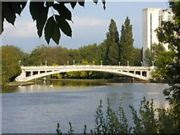
The festival site is beside the river on the north side of Reading and the nearest supermarkets are over the river in the suburb of Caversham. So you see a procession of youngsters coming back over Caversham Bridge loaded with plastic bags from the supermarkets. If there are 70,000 festival goers and each gets only only one plastic bag and half leave that bag as litter......Holy Cow, that's 35,000 plastic bags for starters.

It is not just the lightweight litter. One of the supermarkets, Waitrose, had a guy stationed in the middle of Caversham Bridge to grab back all the shopping carts which the festival goers were using to transport the mountains of drinks and groceries. So there were two large groups of shopping carts either side of the bridge waiting to be wheeled back to the store. We have two lovely rivers in Reading, the Thames and the Kebnnet, plus any number of picturesque smaller tributaries. These all act as rubbish magnets, with abandoned shopping carts being a prominent ingredient. As they are well made and coated with rust resistant material they can stay in a waterway indefinitely until the next periodic clear out. You can bet that many of Waitrose's expensive carts would have ended up in the Thames unless swiftly recovered. And the path along the south bank of the Thames leading to the Festival site is already strewn with drinks cans and fast food debris, to be cleared up at public expense.

Once the Festival starts, the graffiti artists are out in force as well, adding to the £120,000 a year the local council already spends in scrubbing down walls and other vertical surfaces. That's not to mention the noise pollution created by the multi-megawatt amplifiers. The main recipients are the people in the million pound plus riverside homes on the north bank, but it easily spreads to my humble home two miles away on a hilltop; sound bounces in unpredictable ways all over town. And then there's the glorious pollution and traffic congestion as traffic converges from all over the country.

Obviously somebody's making truckloads of money off this. With tickets at £145 ($280) a go just for admission, there's obviously still money to burn in this country despite the impending recession. And that's excluding food, camping gear, souvenirs and travel to the site. Some people were ripped off £145 by bogus internet sites and STILL descended on the on-site ticket office, queing for hours from early morning to pay another £145 to the legitimate sellers for the remaining 3,000 tickets. No wonder they could afford to pay £1 million just for a temporary bridge spanning the Thames, linking to a campsite on the north bank. We have been waiting 80 years for a third Thames bridge in town and a temporary one springs up in days. I am remained of General Patton's Rhine crossing in 1945. The US Army engineers in Patton's sector alone put 5 bridges across the Rhine in 24 hours, under threat of enemy attack. If the US Army had been run by Reading Council, WW2 would still be in full swing. This temporary bridge is a rare example of recycling - it was allegedly made from structures used for the stage on Madonna's last world tour....

Any Christian presence in this pagan celebration? Well, the warmth and hospitality of local people has been evident in some places. The Baptist Church in the centre of Caversham, across the road from Waitrose supermarket, was holding open house, with festival goers welcomed in for coffee, sandwiches, toilets and a chance to recharge their mobile phones. Another church on the south bank was offering coffee sessions in the morning. But, given the sheer size of the affair, the Christian input is very marginal.

Given the size of Great Britain and the 60+ million people squeezed into it, it is a wonder that there is any land left unoccupied by rubbish tips and landfill sites. There's even less spare space this weekend.....