Tuesday, November 18, 2008

St. Barack Worship

Stan,

Thought you might enjoy Peter Hitchen's comments on the Obama media mania.

=======

St Barack’s Expensive Schools and Sneaky Cigarettes.

Still the Obama-worship continues. Scores of Americans denounced me for suggesting last week that Mr. Obama was not divine. How do these people cope with the fact that the President-elect, following a fine old Left-wing tradition on both sides of the Atlantic, is seeking to send his daughters to terrifyingly expensive private schools in Washington DC?

Surely, in between curing cancer and mending the hole in the ozone layer, Mr. Obama can fix the US capital’s atrocious state schools?

And have any of you ever seen a picture of Mr Obama, a heavy smoker, with a cigarette in his mouth? No, nor have I. Why is that?

Wednesday, November 12, 2008

Remembance Sunday

Sunday 9th November was Remembrance Sunday and our parish newsletter had the following poem on the front, which I am sure you would like to share:
--------------------------------------------------------

If I should never see the moon again
Rising red gold across the harvest field,
Or feel the stinging of soft April rain,
As the brown earth her hidden treasures yield.

If I should never taste the salt sea spray
As the ship beats her course against the breeze,
Or smell the dog-rose and the new mown hay,
Or moss and primroses beneath the tree.

If I should never hear the thrushes wake
Long before sunrise in the glimmering dawn,
Or watch the huge Atlantic rollers break
Against the rugged cliffs in baffling scorn.

If I have said goodbye to stream and wood,
To the wide ocean and the green clad hill,
I know that He who made this world so good
Has somewhere made a heaven better still.

This I bear witness with my latest breath
Knowing the love of God, I fear not death.

(Lines found in the Bible of Major Malcom Boyle,
killed in action after the landing on D-Day, June 1944)

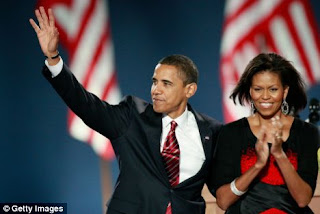
The night we waved goodbye to America... our last best hope on Earth
Dear Stan,

Here is Peter Hitchen's ever razor sharp dissection of the Obama hysteria. He is perhaps unfair in comparing it to the frenzy on the demise of Princess Diana. Having had the misfortune to be in England in 1997 for that tsunami of garbage, hypocrisy and falsification, I don't think even the torrent of drivel written so far on Obama by the British media quite approaches their week long abandonment of sanity that September. It was particularly good to see Peter reminding the British public of the inglorious cesspit of corruption and cronyism behind the Democratic machine in Chicago.

This is Peter Hitchens' Mail on Sunday column

The night we waved goodbye to America... our last best hope on Earth

Anyone would think we had just elected a hip, skinny and youthful replacement for God, with a plan to modernise Heaven and Hell – or that at the very least John Lennon had come back from the dead.

The swooning frenzy over the choice of Barack Obama as President of the United States must be one of the most absurd waves of self-deception and swirling fantasy ever to sweep through an advanced civilisation. At least Mandela-worship – its nearest equivalent – is focused on a man who actually did something.
I really don’t see how the Obama devotees can ever in future mock the Moonies, the Scientologists or people who claim to have been abducted in flying saucers. This is a cult like the one which grew up around Princess Diana, bereft of reason and hostile to facts.

It already has all the signs of such a thing. The newspapers which recorded Obama’s victory have become valuable relics. You may buy Obama picture books and Obama calendars and if there isn’t yet a children’s picture version of his story, there soon will be.

Proper books, recording his sordid associates, his cowardly voting record, his astonishingly militant commitment to unrestricted abortion and his blundering trip to Africa, are little-read and hard to find.

If you can believe that this undistinguished and conventionally Left-wing machine politician is a sort of secular saviour, then you can believe anything. He plainly doesn’t believe it himself. His cliche-stuffed, PC clunker of an acceptance speech suffered badly from nerves. It was what you would expect from someone who knew he’d promised too much and that from now on the easy bit was over.

He needn’t worry too much. From now on, the rough boys and girls of America’s Democratic Party apparatus, many recycled from Bill Clinton’s stained and crumpled entourage, will crowd round him, to collect the rich spoils of his victory and also tell him what to do, which is what he is used to.

Just look at his sermon by the shores of Lake Michigan. He really did talk about a ‘new dawn’, and a ‘timeless creed’ (which was ‘yes, we can’). He proclaimed that ‘change has come’. He revealed that, despite having edited the Harvard Law Review, he doesn’t know what ‘enormity’ means. He reached depths of oratorical drivel never even plumbed by our own Mr. Blair, burbling about putting our hands on the arc of history (or was it the ark of history?) and bending it once more toward the hope of a better day (Don’t try this at home).

I am not making this up. No wonder that awful old hack Jesse Jackson sobbed as he watched. How he must wish he, too, could get away with this sort of stuff.

And it was interesting how the President-elect failed to lift his admiring audience by repeated – but rather hesitant – invocations of the brainless slogan he was forced by his minders to adopt against his will – ‘Yes, we can’. They were supposed to thunder ‘Yes, we can!’ back at him, but they just wouldn’t join in. No wonder. Yes we can what exactly? Go home and keep a close eye on the tax rate, is my advice. He’d have been better off bursting into ‘I’d like to teach the world to sing in perfect harmony’ which contains roughly the same message and might have attracted some valuable commercial sponsorship.

Perhaps, being a Chicago crowd, they knew some of the things that 52.5 per cent of America prefers not to know. They know Obama is the obedient servant of one of the most squalid and unshakeable political machines in America. They know that one of his alarmingly close associates, a state-subsidised slum landlord called Tony Rezko, has been convicted on fraud and corruption charges.

They also know the US is just as segregated as it was before Martin Luther King – in schools, streets, neighbourhoods, holidays, even in its TV-watching habits and its choice of fast-food joint. The difference is that it is now done by unspoken agreement rather than by law.

If Mr Obama’s election had threatened any of that, his feel-good white supporters would have scuttled off and voted for John McCain, or practically anyone. But it doesn’t. Mr Obama, thanks mainly to the now-departed grandmother he alternately praised as a saint and denounced as a racial bigot, has the huge advantages of an expensive private education. He did not have to grow up in the badlands of useless schools, shattered families and gangs which are the lot of so many young black men of his generation.

If the nonsensical claims made for this election were true, then every positive discrimination programme aimed at helping black people into jobs they otherwise wouldn’t get should be abandoned forthwith. Nothing of the kind will happen. On the contrary, there will probably be more of them.

And if those who voted for Obama were all proving their anti-racist nobility, that presumably means that those many millions who didn’t vote for him were proving themselves to be hopeless bigots. This is obviously untrue.

I was in Washington DC the night of the election. America’s beautiful capital has a sad secret. It is perhaps the most racially divided city in the world, with 15th Street – which runs due north from the White House – the unofficial frontier between black and white. But, like so much of America, it also now has a new division, and one which is in many ways much more important. I had attended an election-night party in a smart and liberal white area, but was staying the night less than a mile away on the edge of a suburb where Spanish is spoken as much as English, plus a smattering of tongues from such places as Ethiopia, Somalia and Afghanistan.

As I walked, I crossed another of Washington’s secret frontiers. There had been a few white people blowing car horns and shouting, as the result became clear. But among the Mexicans, Salvadorans and the other Third World nationalities, there was something like ecstasy.

They grasped the real significance of this moment. They knew it meant that America had finally switched sides in a global cultural war. Forget the Cold War, or even the Iraq War. The United States, having for the most part a deeply conservative people, had until now just about stood out against many of the mistakes which have ruined so much of the rest of the world.

Suspicious of welfare addiction, feeble justice and high taxes, totally committed to preserving its own national sovereignty, unabashedly Christian in a world part secular and part Muslim, suspicious of the Great Global Warming panic, it was unique.

These strengths had been fading for some time, mainly due to poorly controlled mass immigration and to the march of political correctness. They had also been weakened by the failure of America’s conservative party – the Republicans – to fight on the cultural and moral fronts.

They preferred to posture on the world stage. Scared of confronting Left-wing teachers and sexual revolutionaries at home, they could order soldiers to be brave on their behalf in far-off deserts. And now the US, like Britain before it, has begun the long slow descent into the Third World. How sad. Where now is our last best hope on Earth?
Wednesday, November 5, 2008

AMERICA BUYS ALL THAT CHANGE BULLSHIT

Dear Stan,
 
Excerpt from the ever-acidic "Daily Mash" on the election result, which came through at about 5am London time (I was listening with one ear to the bedside radio). I should explain that "Lord Dimbleby" is David Dimbleby, one of the BBC's long time presenters. The fact that he and his younger brother Jonathan are always on our screens has, of course, nothing to do with the fact that their late father Richard was for decades the British equivalent of Walter Kronkite. Keep the family business in the family, I say.
 
 
AMERICA BUYS ALL THAT CHANGE BULLSHIT
"Change... yeah... of course"
BARAK Obama swept to victory last night as millions of Americans lapped up all that bullshit about change.

The Illinois senator made history as the first black American to become President and the 44th man to win the office with a lot of vague platitudes and an army of creepy spin doctors.

He told a crowd of 250,000 supporters in his home city of Chicago: "Remember, change is something that happens in the middle of the night when we're all fast asleep and very often the next morning no-one can tell that anything has actually changed.

"I promised you change you can believe in, I did not promise you change you can actually see."
He added: "You believe in Jesus don't you? Right, but have you ever seen Jesus? Exactly. Just making sure we're all on the same page."

Mr Obama said he would bring about change by working closely with the vast and terrifying multi-national corporations that had funded his campaign and pledged to end the war in Iraq in order to create a much bigger war in Afghanistan.

"But instead of some middle-aged white guy doing it, it'll be me and I'm half-Kenyan. What's that about?"

Bill McKay, a college student from Denver, said: "I can't believe I now live in a country where an African American can be elected to the presidency after spending just $600 million on advertising."

He added: "Give me a hug!"

Meanwhile, in the UK, thousands of people talked about staying up all night to watch the drama unfold, but then didn't.

Martin Bishop, from Oxford, said: "I was going to follow the coverage and have the significance of every result explained to me by Lord Dimbleby but then, at the last minute, I decided to go to bed because I don't care."

Denys Hatton, from Guildford, added: "If your life is such that you're placing all your hopes in one politician, then may I humbly suggest you get yourself a crate of superlager and a cardboard box and stop wasting everyone's time."

Friday, October 24, 2008

How the Stock Market Works

Great parable for investors in stock market.....or for people following any short-term panic. (Sent by friend at church)
It was autumn, and the Red Indians asked their New Chief if the winter
was going to be cold or mild. Since he was a Red Indian chief in a
modern society, he couldn't tell what the weather was going to be.

Nevertheless, to be on the safe side, he replied to his Tribe that the
winter was indeed going to be cold and that the members of the village
should collect wood to be prepared.

But also being a practical leader, after several days he got an idea.
He went to the phone booth, called the National Weather Service and
asked 'Is the coming winter going to be cold?'

'It looks like this winter is going to be quite cold indeed,' the
weather man Responded.

So the Chief went back to his people and told them to collect even
more wood. A week later, he called the National Weather Service again.
'Is it going to be a very cold winter?'

'Yes,' the man at National Weather Service again replied, 'It's
definitely going to be a very cold winter.'

The Chief again went back to his people and ordered them to collect
every scrap of wood they could find. Two weeks later, he called the
National Weather Service again. 'Are you absolutely sure that the
winter is going to be very cold?'

'Absolutely,' The Man replied. 'It's going to be one of the coldest
winters ever.'

'How can you be so sure?' the Chief asked.

The weatherman replied, 'The Red Indians are collecting wood like
crazy.'
This is how Stock Markets work.

Thursday, October 23, 2008

Speaking in Tongues

One of the fascinating aspects of my visit to Scotland last June was the reminder that English is not the only British language. The extraordinary little resort of "Tongue" on the far north coast was originally the Gaelic Tonga. The language is still spoken by over 60,000 people on the Scottish mainland and islands, where geographical isolation has helped to ward off the all-conquering English dominance. This was the depressing statistic cited in a recent "Scotland on Sunday" article, where specialists fretted that this "60,000" was the figure below which its long-time survival was unlikely. "Scotland on Sunday" pays lip service by having about a quarter of a page each week devoted to an article in Scots Gaelic. But it is otherwise as marginal a presence in the Scottish media as it is in the population.

The occasion for this gloom was the very expensive launch of a BBC channel dedicated to the Scottish Gaelic language (not to be confused with the Irish Gaelic, which Irish friends assure me is as different from its Scottish relation as German is from English). I wondered if this pessimism was justified. Minority languages hang on in the most unlikely and surprising corners of the world.

The example which surprised me most was the various dialects of Sorbian, a Slavic language spoken by small communities in Eastern Germany. Despite being immersed in the German speaking majority for centuries and persecuted or ignored under Nazi and Communist regimes, they have preserved their language and culture. Estimates of the number of Sorbian speakers vary from 45,000 to 60,000, close to that of Scottish Gaelic speakers. This seems to be a magic survival number, at least for the rational computerised models which predict the number of speakers, and the extinction of the Sorbian language at some point in the 21st century has been similarly forecast . But I would not bet on it.

If you drive in the west of England and scan the radio waves, you may find an unusual text appearing on the radio display: "BBC CYMRU". Yes, you have hit the BBC Welsh channel, which caters for a much larger number of speakers than its Scottish counterpart. Cross the Severn Bridge into Wales and bilingual signs appear by the roadside. Go deep into Wales and you actually hear people speaking Welsh in the street.

You are very unlikely to hear it in the capital city of Cardiff, where Welshness is flaunted mainly by sticking a dragon on everything from the sides of buses to the postage stamps. But go to the wild and beautiful north and you hear young men out on their lunch break in small town centres in animated discussion in their native tongue (most likely of Rugby results). With 600,000 speakers, its survival looks mor assured than that of Scottish Gaelic.

I stopped at a farmhouse in North Wales for the night during a brief holiday in 1991 and my charming hostess served me tea and biscuits (cookies). The phone rang and she immediately switched to high speed Welsh talking to a friend. She took me upstairs to the bedroom, which was obviously the children's bedroom on other occasions. The brightly coloured spelling chart on the wall did not show "A for Apple" and "B for Bird". The Roman alphabet was taught using Welsh words.

In the 1970s I worked with a colleague whose second language was English. He had spoken only Welsh up to the age of seven. But then he was of an older generation, immediately before the all-conquering power of video and TVs in every child's bedroom showing multiple TV channels. The seductive attraction of this beautiful language was vividly illustrated in the recent film "The Edge of Love" about two of the women in the crowded love life of the poet Dylan Thomas. In one very telling scene Thomas and Vera, one of his old flames, sing a song in Welsh in front of her English husband. The bond of a common childhood language is something which the husband cannot share.

Many Welsh schools provide education in Welsh as well as English and universities still offer first and higher degrees. A friend has recently achieved first class honours in Welsh studies at Aberyswyth University.

Also there is official endorsement for Civil Service puposes. If you write to a Government department in Welsh, your letter should be answered in Welsh. After all, it is a much more ancient language than English. For a few years in the late 1980s and early 1990s I maintained the Department of Social Security's collection of standard letters - about 2,500 WordPerfect files covering all the major benefits - sickness, incapacity, widows pension, etc. One initiative which was proposed was to duplicate all these letters in Welsh. Two major problems were immediately obvious. One was finding enough skilled translators to turn all these documents into legally accurate Welsh. The second was how to shoehorn these extra 2,500 files onto the ancient PCs in local offices around the country. Even with the help of data compression software, their tiny hard drives were already bursting at the seams. Fortunately I moved on to other tasks and dumped my paperwork with my successor before we reached that impasse.

The Welsh, Scottish, Irish and Sorbian languages are all recipients of substantial amounts of public funds to assist their survival. There is good reason to doubt the effectiveness of public subsidy in the face of the overwhelming English linguistic imperialism. When even major European languages such as German and French are challenged on their home ground, it would be amazing if marginalised language groups could hold their own. One scathing Irish commentator described the results in the "Gaeltacht", the Gaelic-speaking western fringe of the Irish Republic, "We are spending millions to subsidise a Gaeltacht of rural slums where the everyday language is English, employment is unobtainable and a once proudly independent people have been corrupted into relying on public handouts". That was written well before the "Celtic tiger" revolution in the Irish economy transformed the prospects of people in the poverty-stricken west. But this financial transformation has had other utterly unpredicted results; the minority language you are most likely to hear in the west of Ireland these days is Polish. The regional centre of Limerick was grimly portrayed in "Angela's Ashes" as a place that dynamic young people of the 1940s and 50s were desperate to escape at any price - to England, Australia, America, wherever. Now it is invaded by dynamic young Poles to the extent that Polish shops, restaurants, banks and a medical centre have sprung up.

We are prepared to spend huge sums to conserve ancient buildings and works of art. A language embodies the essence of a living culture. Imagine if English disappeared as a living language and all the works of English literature could be appreciated only in translations and by a few eccentric academics studying dusty texts. It seems equally necessary to keep languages alive as to keep threatened species of animals in being; to have a living population of speakers rather than a mass of neglected textbooks and forgotten classics in the corner of a library.

At least one neglected language needs no public subsidy to keep it alive. At St William of York I go to the 900am Mass on Sunday. We cannot linger too long afterwards for coffee and conversation. The cups have to be washed and stored away because the Latin Mass Society (LMS) have arrived for their Mass at 1100am. A whole new wooden platform is quickly assembled in the sanctuary, so that the post-Vatican altar for Mass facing the people can be used for Mass where the celebrant has his back to the congregation. A sizable congregation turns up, some from as far as 20 miles away. Minivans carrying large families crowd the car park; even the parents are clearly too young to remember the Latin Mass as it was said up to the 1960s. You can hear the traditional Latin Mass in many parts of the country, but the next nearest venues would most likely be in Oxford 30 miles to the north or London 40 miles to the east.

I say "hear" the Mass because for most of the service the congregation is silent and the priest alone recites the prayers. I have been to a couple of these Latin Masses and they are a striking reminder of what a recent innovation the dialogue Mass is. It is a 1950s innovation. For 19 centuries Mass was recited as the LMS arrange it today.

It is also a reminder of how recently the Church was so powerfully united by one language. Wherever you went in the world, it was as if the curse of Babel had been temporarily suspended, for at least one sacred hour. We could all share the same words without a translator. Like the first Pentecost, people from all over the known world could hear about the marvels of God, simultaneously, albeit not in their native languages.

Go to Lourdes or some other major international religious site nowadays and you get a taste of linguistic bedlam. As if the major services at Lourdes were not long enough, you get some sections recited 4 or 5 times in French, English, Italian, Spanish and German - plus extra repeats if the Poles or Flemish-speaking Belgians (as opposed to French-speaking Belgians) are in town..... 50 years ago it was one united service which everyone could share spontaneously. It is a reminder of the tensions between the advantages of linguistic unity and preserving precious jewels from the margins of human genius.

Friday, October 17, 2008

Human Perfection and Imperfection

[This post by Stan. Bill sent me the article below, and here are my comments on it.]

Click HERE for the full article by Amy Becker about her reflections on her Down syndrome child Penny, pictured at the right with her husband Peter. The title link will take you to FIRST THINGS' website. (More links to her stuff below.)

The article begins below, but I encourage you to read it to the end and try to fully understand Amy's take on what it means to be perfect and imperfect, especially as we automatically apply the concepts to babies, but also to ourselves.
"What shall it gain a man if he should gain the whole world but loose his soul?" (Jesus' words from somewhere in the Gospels.)
At first glance this article looks like it might be an argument against abortion when the child has Down syndrome, and indeed it is that. (cf. Sarah Palin and the fear people have of her because she sees perfection in babies at a different level than most. Her insight into this is supernatural and transcendent...a valuable asset for a world leader.)

But the article is more significant than just an argument against abortion. As Becker explains there is an extra chromosome that gave Penny the disease (something extra that apparently "distorts" physical perfection). Becker inmplies, but never says it, that there is a more serious affect of adding extra "chromosones" -- to our lives and culture. Such "extras" have a more serious impact on our spiritual perfection before God. Penny's chromosome "problem" is small compared to what we do otherwise to our "spiritual" chromosomes.

But her point is actually better than that.

She writes, "humanity includes limitations and dependence on one another." But what she is really saying is that humanity is not defined by culture's view of physical "perfection" but by God's view which NECESARILY includes limitations and dependence. That is "humanity is DEFINED as something that includes 'limitations' and 'dependence.'" To be truly human is to be dependent on others and God. If we believe we are independent we buy into Satan's lie that we can be like God. Humanity IN ITS PERFECTION requires, demands, begs, screams for limitations and dependence. IN THOSE THINGS we are made PERFECT (James 1).

She writes, "when we conceive of healing simply as miraculous cures for abnormal states of being—blindness, deafness, cognitive delays—we miss the point." Indeed! Some years back I began to look at all the aged and mentally dependent senior citiziens I was meeting in several churches that ministed to such folk. It occured to me that one of their purposes in life was to teach us abled body, and mentally "capable" people to CARE for them. By their "disabilities" they were teaching us to love, to be charitable, to give of our time and resoruces, to be like Christ. Just as we can never pay back Christ for all he's done for us, so these aged and mentally dependent people I was meeting could never pay back their caregivers. But that was the point. When society sees them as "disabled" or "not living fully" or as "unnecessary" we should be seehing them as just the opposite, if we have any interest in seeing heaven and God. Humanity was designed as a DEPENDENT DISABLED specese for a reason... so we could accept God's love, and share it with others.

Indeed, Penny, in the ways that matter most (eternal values) is more perfect with her Downs than many others. Pray for us Penny. (More pictures of Penny at link below.)
BABIES PERFECT AND IMPERFECT
by Amy Julia Becker

Copyright (c) 2008 First Things (November 2008).

Our daughter was born at 5:22 p.m. on December 30, 2005. Two hours later, a nurse called my husband out of the room. When he returned, he took my hand and said, “They think Penny has Down syndrome.” As this news began to make its way into my consciousness, we heard shouts from the room next door. Another child had been born. “She’s perfect!” someone exclaimed about that other baby. “She’s perfect!”
Amy's website, with more pictures and her other writing is HERE. She's working on a Masters in Divinity at Princeton, and has a book coming out. Her blog is THIN PLACES. Thanks to my bogging-pal Bill Murphy for sending this. This is also posted on my blog at CROSSING NINEVEH.