Tuesday, June 16, 2009

Planes, Malls, and Three French Corpses

Farnborough lies twenty miles south of Reading. At one time it was distinctly separate from the neighboring town of Aldershot, “Home of the British Army”. Now the two boroughs have merged into one suburban sprawl, so the only way you can tell the difference is the boundary signs as you drive from one to the other.

Farnborough is the birthplace of British aviation. Every two years the airfield hosts a major air display. As you drive in from the north, you pass a full size replica of Britain’s first jet aircraft, the Whittle of 1941.It is proudly mounted in flying pose at the entrance to the airfield or “aerodrome” as some road signs quaintly describe it. See http://www.frankwhittle.co.uk/content.php?act=viewDoc&docId=9&level=top.

The town centre is an unremarkable assembly of malls and car parks, with clones of every major British bank, clothes shop, coffee bar, fast food provider and mobile phone retailer. The only thing to distinguish Costa Coffee here from the same outlet in hundreds of British malls and high streets is the replica World War 1 biplane suspended above your head as you consume your cappuccino.

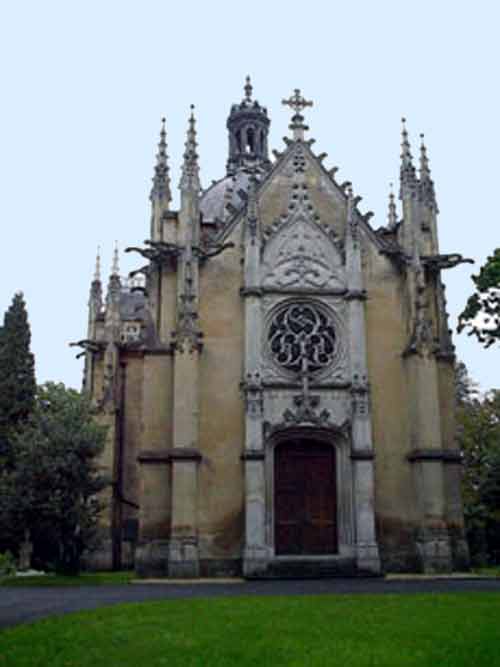
But walk for a few minutes from the shopping malls and you enter a parallel universe. Take your life in your hands, cross the A325 road, pass through a pair of electric gates next to a unappealing apartment block and climb the hill beyond. In less than 200 yards you find yourself in front of a monastery with a very French domed church alongside it. All French features present and correct: 9 foot gargoyles, marble floors, extraordinary glass in the side windows, three members of the Bonaparte family resident in the crypt.

Yes, Emperor Napoleon 3rd, the nephew of Napoleon Bonaparte (the loser of the 1815 Battle of Waterloo), is buried here. Alongside Napoleon 3rd there is his wife the Empress Eugenie and their only child, Prince Louis who died tragically at the age of 23 in 1879. This marked the end of any realistic hopes of a Bonaparte restoration in France at a later date. Many Frenchmen had regarded the young Prince Louis as the Emperor in exile. For better or worse, their beloved France would henceforth be a secular democracy and their bodies would lie in permanent exile in a foreign land. “Buried” is not strictly the right word; entombed is more correct, as their corpses are housed above ground in three splendid sarcophagi made of Aberdeen granite. These tombs are allegedly similar to those used in the British Royal family’s private burial site at Frogmore. The Abbey website ( http://www.farnboroughabbey.org/) explains:

In 1880, the Empress Eugénie bought a house in Farnborough. Crushed by the loss of her husband Napoleon III in 1873 and the death in 1879 of her 23 year old son in the Zulu War, she built St Michael’s Abbey as a monastery and the Imperial Mausoleum.
Dom Cabrol, the prior of the French Abbey of Saint Pierre de Solesmes, had dreamed of a monastic foundation dedicated to liturgical studies, but no suitable property or funding had been found, though the vicissitudes of the anti-clerical France of the 1890s made the thought of a house abroad increasingly attractive. The Empress Eugénie invited these French Benedictines here in 1895 and thus the daily round of work, prayer and study began.

Monsignor Ronald Knox, who was received into the Catholic Church here, described the Abbey as ‘a little corner of England which is forever France, irreclaimably French.’ In 1947 a little band of monks came from Prinknash Abbey, near Gloucester, to anglicise the house and ensure the continuity of the monastic life here. The last French monk, Dom Zerr, died in 1956.

The community today draws on the richness of more than a hundred years of monastic prayer and witness in this place and more than 1500 years of Benedictine tradition. “

Farnborough Abbey is a Benedictine foundation, but these are a very distinct type of Benedictine. In contrast to the Benedictine monastery at Douai, twenty miles west of Reading, the Farnborough Benedictines are a contemplative community. Douai is open all the time; you can casually drop into the splendid church at any time of the day and join the monks at one of their regular Offices. Farnborough is open once a week at 300pm on a Saturday for a guided tour, but otherwise the monks preserve their privacy and seclusion two hundred yards from the bustle of 21st century England. At present there are 7 monks ranging in age from 23 to 96. The oldest member can recall the early, totally French days when any Englishman was a highly suspect intruder. There is typically a new novice every year, but there is a steady turnover; the majority do not persevere. Seven monks sounds very few, but it is enough to maintain a vibrant spiritual and working community. The monastery was never intended to be large, unlike some of the huge European houses which accommodate 200 or 300 monks. The most that could reasonably be housed at Farnborough is 14.

The electric gates beside the apartment block are mostly kept shut to preserve the sense of enclosure for the monks. If you want to get in, ring the bell, speak into the intercom, and give a good reason for intruding on their prayers and work. They aim to conserve St Benedict’s ideal life balance of prayer, manual work and study. They run a small farm with a mixture of cows, chickens and bees. But the work for which they are best known is book publishing and binding. Also the monastery now houses the National Catholic Library. I visited this library many years ago when it was housed near Westminster Cathedral in London. For years the Franciscans maintained this incredible resource, but had to give it up. It was threatened with dissolution and dispersal until the monks offered it a new home. So, between the NCL and their own library, they now have 125,000 books on site for 7 monks.

What a place to visit and how much politicking, sadness, humour and history is packed into these few acres. Napoleon 3rd died in exile 3 years after the catastrophic French defeat in the Franco-Prussian war of 1870-71. When the war started, the cry in Paris was “A Berlin!”. Unfortunately the Prussians crushed the French Army and surrounded Paris. When Napoleon died in 1873, he was buried at St Mary’s Church, Chislehurst, south-east of London. There were various ideas for a suitably dignified memorial/mausoleum in that area, but none came to pass. The Catholic Church in Chislehurst was the property of the diocese. Land near the church belonged to a Prussian who had served in the 1870 war and was none too eager to sell any part of his land to accommodate the redundant Emperor.

Eventually his widow Eugenie had the opportunity to buy Farnborough Hill, a grand house built in a somewhat Continental style and sited in a huge estate. She hired an eminent French architect to extend it to accommodate her huge collection of Napoleonic memorabilia. It is now a Catholic girls’ school (see http://www.farnborough-hill.org.uk/ for a glimpse of this Grade 1 listed building). She arranged for the present monastery and church/Imperial Mausoleum to be built on a neighboring hill. Then she invited the monks. Part of the appeal for the monks was the fact that Farnborough had two railway stations. From one station you could reach Oxford and its Bodleian Library in a hour. From the other station you could reach London and its huge range of libraries in an hour. This was very attractive to the scholarly Benedictines.

When Napoleon’s coffin was finally moved from Chislehurst to Farnborough, history had one big joke to play. His remains were transported by rail…via the huge Waterloo station in south London. (See “The Bourne Ultimatum” for the memorable chase across this crowded terminus). Eugenie lived until 1920, though she said that she died in 1879 with her only child.

French politics is as heavily burdened by the past as that of any other nation. Napoleon Bonaparte is buried in great style in Paris. Having visited his tomb in 2006, I could only regard it as a monstrous waste of a glorious church. Yet his nephew remains in British exile, long after the cause for his staying abroad has faded away. Every so often there is a move to try to repatriate him, but so far the monks and the Bonapart family in France remain united in wishing him to stay in Farnborough.

His life continues to be celebrated quietly in unexpected ways. 2008 was the 200th anniversary of his birth and several diplomats from France and other countries turned up at Farnborough to pay homage. Most amazing of all was the Romanian ambassador. What on earth was he doing here? Well, Napoleon 3rd had helped to save Romania from being colonized by the Ottoman Empire and they were still grateful. The Swiss wanted him to be buried on Swiss soil, as the Bonapart family at one time spent a long exile in Switzerland. So a packet of Swiss soil is tucked underneath his sarcophagus.

I was reminded of my visit to Peterborough Cathedral a few years ago. Every year there is a service at the tomb of Katherine of Aragon, Henry 8th’s first and ever-faithful wife. As she was Spanish royalty, the Spanish Embassy in London always sends a representative.

The week before my visit was the 130th anniversary of Prince Louis’ death. His sarcophagus had at its base several wreaths with French inscriptions. Who will bother to remember any of our statesmen or celebrities in 130 or 200 years time? In most cases, we fervently wish that we could not remember them today.

Sunday, June 14, 2009

Guilty Until Proven Guilty

It is both reassuring and disappointing to notice that human nature does not change. Our most recent public sensation was hot enough to share the front pages with the latest disgraced Member of Parliament’s outrageous expense claims. As several perceptive commentators have noted, the age of the witch hunt is ever with us and this week’s witch is one Vanessa George, a nursery worker from the original Plymouth in south-west England.

Mrs George qualifies as Demoness of the Week due to allegations that she took pornographic photos of the little children in her care and sexually abused some of them. Apart from the inherent shock value of the alleged offences, the yellow press are plainly lining her up as Myra Hindley Mark 2. But legal quibbles such as “Innocent till proven guilty” can be safely ignored, both by the media and the enraged mob at her court appearance, who spat on her and attacked the van in which she was transported.

Theodore Dalrymple had ample exposure to evil in the course of his career as a prison doctor and described the same mentality among prisoners. Many prisoners considered themselves hard done by and claimed they had been set up or framed by the police or judicial system. But no such benefit of the doubt was extended to those suspected of sexual offences against children. They were instantly guilty if charged and could expect the most ferocious punishment from fellow inmates.

Before rushing to judgement, the press might have remembered the recent fiasco of two nursery workers in Newcastle, at the other end of England. This pair were found to be innocent after years of agony when they had been falsely accused of similar offences. But, hey, what's the problem about destroying the lives of Mrs George, her husband and two teenage daughters when there's so much money to be made?

The intelligent and exceptionally well informed journalist Dominic Lawson recently wrote that the British media have been in mourning since the death of the child killer Myra Hindley in prison in 2002. For the past 40 years, the images of two blond women have been guaranteed to sell newspapers, magazines and TV programs. One is Myra, the other is Princess Diana. Admittedly Diana’s hair colour was natural, while Myra’s came out of a bottle. But her 1960s iconic image of the hard-faced bitch with the blond beehive hairdo is ever enduring and endlessly reproduced. Later pictures of her in prison, with dark hair and a sweet smile, make her look like your favourite aunt and don’t fit the fairy story so well.

Unless you have lived in Britain for the last forty years, you cannot imagine the degree and quality of hatred focused on this woman. The only remotely comparable kind of loathing might be that directed at Adolf Hitler. But even Hitler’s public presentation lacks the peculiarly venomous edge which Hindley’s name instantly provokes. I was with friends on the evening in 2002 when her death was announced on TV and one friend’s vehement and heartfelt comment was “Good!” This friend is a really sweet natured and loving person; she was also born after Hindley’s trial and conviction.

Myra’s crimes were hideous, though not exceptionally horrible by the standards of British murders of both children and adults. I can think of numerous child killings over the last 40 years that were even worse and those perpetrators are almost completely forgotten. The barbaric killing of two French students in London in 2008 made Hindley’s crimes look mild in comparison. Yet I expect the names of their two vile killers to be largely forgotten a few weeks after they begin their 35+ year sentences. But she was caught in a perfect storm of circumstances partly outside her control.

Obviously the serial killing of children excites particular revulsion. And the fact that a woman participated made it doubly heinous, even though she was an accomplice who did not physically kill the children. True, she need not have associated with the depraved Ian Brady or gone along with his murders or assisted in the burial of the bodies. But there were two extra factors which have compounded and extended the infamy of the “Moors Murders” case, as it is known (The bodies were buried in the bleak high moors east of Manchester).

The first was the audio evidence. When she came to court in 1966, even hardened policemen were shaken to the core as tape recorded screams of their tortured 10 year old victim, Lesley Anne Downey, were played back. Reasonably priced tape recording equipment had only recently become available to the general public and Brady had put it to use to record his crimes. As far as I know, it is still the only murder in history where the crime was tape recorded. It helped to seal Brady and Hindley’s conviction and added another level to the public outrage at her crimes. Also the audio evidence had a visceral and immediate impact. No verbal testimony from any number of witnesses or academic pathologists could equal the searing agony of the little girl pleading for mercy and finding none: “Please let me go home to my mummy…..I swear on the Bible, I won’t tell anyone”.

No wonder that her crimes have achieved almost mythical status as examples of ultimate human evil. I say “her” crimes because Hindley is associated forever in most people’s minds as the more evil of the pair. No body wants to hang a woman. But in Hindley’s case nearly everyone would gladly have made an exception. Except that option was no longer legally possible.

Here we have the second complicating factor in her case. The last two people to be executed in England were hung in 1964. The use of the death penalty was suspended for a few years until formal abolition around 1970. As a sop to public sentiment, various officials and politicians promised that “life imprisonment for murder would mean life”. The lying bastards. “Life imprisonment” most usually means 10 years or so before release on licence. In the case of Hindley and Brady, it did turn out to be a life long sentence. She died in prison and he is still inside, probably having slid into insanity by now. So, for the thirty-six years of her imprisonment, much of the public could justly feel that an exceptionally evil killer had cheated the gallows.

The relatives of the victims publicly and repeatedly threatened to kill them if they were released. The politicians and officials responsible for parole thus had an extra nasty dimension to consider, apart from the usual established criteria for releasing a convicted killer back into the community. If Hindley was released (as she should have been freed under the normal rules in the 1990s), she would almost certainly have been killed by vigilantes. No new identity or “secret” address would have survived for 48 hours; a corrupt official would have sold it to the press before she was freed. And if she was killed and her murderers brought to justice, would a British jury convict? You might get another notorious case of a jury approving of murder, as happened in Australia where a vigilante policeman used his service revolver to kill a man he accused of molesting a relative. The victim was dead and couldn’t defend himself in court, but the policeman walked free despite there being no reasonable doubt as to his guilt.

But Hindley was not just a reviled serial killer. She was also a great long term investment from the media viewpoint. She was only in her early 20s when convicted and the reporters knew that they had a wonderful story for decades to come. For the rest of her life she was a guaranteed earner for the British press, who were and are happy to ignore any law or code of ethics in the pursuit of a great story. Any news of Hindley’s life in prison or any hint that she might be soon released were guaranteed front page coverage, along with the understandable but still unappealing chorus of hatred from a group of her victims’ relatives (who I understand were kept on a retainer by at least one tabloid).

Lord Longford, the Catholic campaigner for prison reform, quickly discovered this when he befriended Hindley. Whenever he visited her the press were waiting for him at the prison gate. He had arranged his visits confidentially in advance, so it was plainly a corrupt prison officer who was leaking the information to the newspapers. But despite his protests no one was ever detected or punished. No British politician would ever dare to offend the press barons.

So ever since her demise the newspapers have been looking for a replacement. Most of those who looked like possible candidates have proved to be fifth-rate villainesses and quickly forgotten. Even Vanessa George looks too insubstantial to be a convincing understudy for Hindley. But the search goes on.

The sad wasted life of Myra Hindley contained extra embarassments for Catholics in Britain. Lord Longford always had something of the Holy Fool about his public persona and his long association with Hindley did neither of them any favours. He was convinced that she was a good Catholic girl who had sincerely repented of her crimes and deserved to be released. I could feel only that if she truly understood the nature of her crimes, she would understand that she fully deserved a full life sentence and should accept that with resignation. As a prison visitor, I met another prison visitor who had visited Hindley and gained an utterly different impression of her character and disposition. She declared unequivocally that Hindley was “the most evil person she had ever met”. As this prison visitor was not nationally famous, merely a local volunteer, she had no political influence or powerful friends and was thus of no use to Hindley in lobbying for an early release.

In his article for “The Sunday Times” on 31st May ( http://www.timesonline.co.uk/tol/comment/columnists/dominic_lawson/article6395923.ece ), Dominic Lawson considered the present chaotic shambles which poses as British policy for sentencing criminals of varying degrees of villainy. He quoted effectively from a great Christian thinker who Lord Longford might have been wise to consider before he endorsed Hindley's pleas for clemency:

“The advocates of our system maintain that it is more humane, since it allows for the prisoner who displays penitence to be released much earlier. Sixty years ago CS Lewis demolished this conceit in his essay The Humanitarian Theory of Punishment. He pointed out that a sentence based solely and inflexibly on the wickedness perpetrated – the concept of just desert, which was increasingly being denounced as “mere retribution” – was the only way of linking punishment and justice.

By contrast, said Lewis, if sentences served were based on a subjective assessment of the rehabilitative process, “grumpy unrepentant prisoners” could be consigned to perpetual incarceration while those cunning enough to “cheat with success” would be freed.

The dystopia foreseen by CS Lewis is now the English system of justice.”

Thursday, June 11, 2009


Dear Stan,

I have driven past the church of St Laurence in the historic town of Petersfield (40 miles south of Reading) many times. Its styling is eye catching and unusual for a small town Catholic parish church

http://www.petersfieldparish.org.uk/page/Home.aspx

In fact, Petersfield has an excellent collection of churches. The Methodist church across the road from St Laurence is very handsome, but the 800 year old St Peter in the ancient Market Place is a gem of a building. Of course, it was a Catholic church for over 300 years until Henry 8th came along. But the Anglicans have done a great job of preserving it and adapting it for modern needs, most recently in the year 2000. It is very visibly a vibrant parish church, as befits its position in the heart of this lovely town. The Farmers' Market was in full swing in the Market Place a few yards from its doors when I visited.

As I admired its refurbished interior, a couple came in. The man explained that it was a year since their marriage in that historic setting.

St Laurence's most famous parishioner was one Sir Alec Guinness, who, between "Star Wars" and " Passage to India", lived nearby. Pity that I could not get inside St Laurence. Like nearly all Catholic churches in England, its doors remain firmly locked between Masses. I am sure that its interior is good match for its very striking shell.

Thursday, June 4, 2009

U.S. One of the Largest Muslim Countries?

Dear Stan,

Here is a fascinating excerpt from Melanie Phillips' blog of 3rd June 2009. It is not often that you know that a politician is lying the moment he utters a sentence. Usually, you just don't have the background knowledge to instantly detect a blatant falsehood. And even if you suspect that you're being fed garbage, you don't have the time to research the facts. But the Leader of the Free World has spoken one piece of drivel which almost all his audience must have known immediately to be untrue.

Even if you lived in Detroit, with a very large concentration of Arab-Americans, you would have your doubts about the USA being "one of the largest Muslim countries in the world". Years ago I read that 80% of Arab-Americans were Christian and I suspect that has not changed too dramatically as more and more Arab Christians flee the Middle East.

=========================
Wednesday, 3rd June 2009
A statement -- or an aspiration?
9:57am
Having previously declared that America is ‘no longer a Christian nation’ – to be precise:
... At least not just. We are also a Jewish nation, a Muslim nation, and a Buddhist nation, and a Hindu nation, and a nation of nonbelievers...
Obama has now announced, on the eve of his pilgrimage to make obeisance to the entire Islamic world, that the US can be seen as a Muslim country:

‘And one of the points I want to make is, is that if you actually took the number of Muslim Americans, we’d be one of the largest Muslim countries in the world,’
Mr. Obama said.
Uh? Here are some statistics of the number and percentage of Muslims in various countries:

Indonesia: 207,105,000 (88.2%);
Pakistan: 167,430,801 (95%);
India: 156,254,615 (13.4%);
Turkey: 70,800,000 (99%);
Egypt: 70,530,237 (90%);
Nigeria: 64,385,994 (45%);
Iran: 64,089,571 (98%);
Algeria: 32,999,883 (99%);
Morocco: 32,300,410 (99%);
Afghanistan: 31,571,023 (99%)
Saudi Arabia: 26,417,599 (100%)
USA: 4,558,068 (1.5%)
Just what planet is this US President on? Or is this not a statement but an aspiration?


=========================

Wednesday, June 3, 2009

Invisible Massacre


Here is part of the ever thoughtful Archbishop Chaput's article in "First Things" on 2nd June 2009. He was reflecting on the uses of technology. He mentions the downside of the invention of cars. "traffic jams, oil dependency and pollution". Is he leaving something out.....like mass carnage? The fact that such an intelligent writer could omit the most obvious downside of widespread car use is testimony to how invisible death on the roads is.

Yesterday's Air France disaster over the Atlantic finally pushed the Members of Parliament expenses row off the top of the British news agenda for a day - this never ending scandal went down to the Number 2 slot for a day, so I expect it to be back at Number 1 tomorrow and for every day until a General Election is called or the "Daily Telegraph" runs out of politicians to destroy. 228 people have probably died in that crash. The death toll on the British roads, among the safest in the world, is 3,000 a year - more than 12 Air France disasters. The death toll on US roads is over 40,000 a year - an Air France disaster every two days.

The Chicago Tribune ran a series of articles some time ago about Illinois high school students killing themselves in a series of gruesome and easily avoided accidents (e.g. if they had been driving sober or at less than 100 mph). Perhaps older or younger citizens' lives were less valuable or less newsworthy, because I never saw any similar series on accidents involving other drivers. But most of the time road deaths never make the news unless it is an exceptionally high death toll.
============================
"The historian Edward Tenner once warned that every new technology brings with it a "revenge of unintended consequences." We invent cars, for example, to move us more quickly--and of course, they do. But we also end up with traffic jams, oil dependency and pollution. We're never as smart as we think we are. The modern scientific mind likes to imagine itself as Prometheus, the hero of Greek myth who's punished by Zeus for stealing fire from the gods and giving it to humans. But we're really much more like the Sorcerer's Apprentice: smart enough to use the Master's magic, but not smart enough to know where it leads or how to control it.
============================

Monday, June 1, 2009

Because It's WRONG! (Part 5)

Here is a great article from "The Independent" of 30th May 2009. Richard Ingrams is one of the surviving founders of "Private Eye" - a fondness for alcohol and general unhealthy living has carried off some of his friends and colleagues from the early 1960s. But Richard is still going strong. He often refers to commuting to London from Reading, so he obviously lives somewhere in this area. But as so-called "real life" is always crazier than the most heroic satirical efforts of "Private Eye", perhaps he realises that satire is redundant nowadays.

His article on the recent approval of a gay clergyman by the Church of Scotland is a prime example. Such an event would have been regarded as beyond the bounds of worst-taste satire when "Private Eye" started. But it is now hardly surprising - just the final end stage of the disintegration of Scottish Christianity, so evident on my holiday in Scotland in 2008 when I came across any number of closed churches converted to other purposes.

Remember the stern 1920s religion depicted in "Chariots of Fire", when the great Scottish missionary and athlete Eric Liddell refuses to run even an Olympic heat on the Sabbath? Some of Eric's spiritual descendants are definitely NOT taking the admission of gay clergy lying down, so we have yet another schism in full swing. The more vacuous talk there is of "Christian Unity", the more disunity there is in real life.

As Richard so truly says, "we are all very relaxed about the breaking of the marriage vows". In the last few weeks, yet another pair of my Catholic friends (with two children) have split up. Admittedly, I was not surprised from a Catholic viewpoint as their marriage had long struck me as a good business arrangement rather than a true Christian union, but it was still intensely depressing.

And if even the formerly rigorous Kirk in Scotland is indifferent to adultery and sodomy what is wrong? What is the purpose of such a "Church", except as a a vaguely spiritual welfare and social society?

===============================================

What was a vocation has turned into just another job

Being a priest, in the eyes of the secular media, is no different from any other job. It follows that we should no more think of objecting to a gay minister of religion than we would a gay dentist.

Hence the general rejoicing that the Church of Scotland has voted in favour of the appointment of its first ever gay minister, Mr Scott Rennie, 37, pictured.
Here is an organisation long associated with the harsh puritanism of John Knox now showing itself to be tolerant, forward-looking, modernising and all kinds of words that don't mean anything much.

The fact that Mr Rennie was married with a young child but has left them, is now divorced and living with a man is neither here nor there. In today's world we are all very relaxed about the breaking of the marriage vows. "Jesus loves me," says Mr Rennie, so it must be all right then.

The issue of openly gay clergy has already caused a major upheaval in the Church of England and now the same sort of crisis is threatening the Church of Scotland.
But the issue is not really to do with homosexuality. The only way the churches can survive is if priests and ministers are seen to be making personal sacrifices which the rest of us are not prepared to make. Then they will be respected.

As soon as they feel free to marry, get divorced, remarry, live with other men and so on then they are telling us that there's nothing so special about being a priest. It's just another job, like being a dentist. So no wonder the media are being so supportive.

Monday, May 25, 2009

Farmer Builds Model of Biblical Temple


Here's link to incredible model and many pictures:
http://www.letterofrepentance.com/FarmerbuildsmodelofBiblicaltemple.html

Dear Stan,

Yes, I saw the report on this incredible project in a British newspaper. Norfolk is a county on the east coast of England, about 100 miles north-east of London. As it is very flat, it was the site of numerous RAF and USAAF bases in WW2. Its biggest Christian claim to fame is the major shrine of Our Lady of Walsingham, frequented by both Catholic and Anglican pilgrims. Its major city, Norwich, has TWO cathedrals - one Catholic, one Anglican.

I love models of anything. The best one I have seen recently is an incredibly detailed model of Worcester Cathedral (about 80 miles north-west of Reading) which was displayed in a side aisle of this magnificent building. On the upper levels of the Lutheran Cathedral in Berlin there are several excellent models, to varying scales, of the entire cathedral and parts of its structure.

To my stunned surprise, I discovered a major Catholic cathedral only twenty miles south of Reading today. I was briefly checking out the Army town of Aldershot on a day's random driving. There was a very large and handsome Victorian church in the heart of the military district. I wandered in, assuming that it was an Anglican church as it was so similar in general style to other Anglican parish churches in Southern England. But no, it was the Cathedral Church of the Armed Forces and the seat of the Catholic bishop to the Forces. I ended up enjoying coffee and biscuits (cookies) with the priest and congregation who had just finished Mass. Like other aspects of the Church in England, the chaplaincy to the Armed Forces exists in a parallel universe with hardly any overlap with the main diocesan structure. But this Cathedral's congregation is divided between military families, who are mostly short-stayers before transferring to another Army town, and civilians who are the long-term backbone of the parish.

This very splendid building, with lavish stained glass, mosaics and statues, was indeed an Anglican church up to 1973 when the Anglicans offered it to the Catholic chaplaincy. In the entrance porch a display case contains the trowel used by Queen Victoria to lay the foundation stone in 1892. Now there's a claim to fame; I suspect it is the only Catholic church in the world to have its foundation stone laid by Queen Victoria.

http://en.wikipedia.org/wiki/Cathedral_Church_of_St._Michael_and_St._George

Here is the link to the Wikipaedia article on the Cathedral Church of Saints Michael and George in Aldershot. It was designed by two military engineers. Not many Catholic churches have such architects, I bet.....though there is the wonderful little Italian chapel in the Orkney Islands in Scotland, which I told you about last year. As that was converted from two prefabricated Nissen huts, you might argue that that was also a military building.